Let me tell you about Margaret.
She's been standing outside the door of my rehearsal room, metaphorically speaking, for about three years. She loves music — always has. She sings along to the radio when nobody's listening. She went to a choir concert a while back and sat in the audience feeling something she couldn't quite name: a pull, a longing, a quiet little voice saying 'I wish that were me.' And then, on the drive home, a louder voice drowning it out: 'Don't be ridiculous. You're not a singer.'
Maybe you know Margaret. Maybe you are Margaret.
This post is for her. And for you.
I've been directing choirs and working with singers for a long time, and if there's one thing I've learned, it's this: the people who would benefit most from joining a choir are often the very last ones to walk through the door. Not because they don't want to. But because somewhere along the way, someone made a thoughtless comment and planted a seed of doubt, and that seed has been quietly growing ever since.
So before we talk about anything practical, let's deal with the thing that's really stopping you.
"But I'm Not a Good Singer"
I need you to hear this clearly, so I'll say it plainly: the vast majority of people who believe they cannot sing are wrong.
Not slightly wrong. Profoundly, categorically wrong.
The human voice is an instrument. Like any instrument, it responds to guidance, practice, and encouragement. The people who tell you they are "tone deaf" almost never actually are — true tone deafness is genuinely rare, affecting a small fraction of the population. What most people have is an untrained voice and a bruised confidence. Both of those things are entirely fixable.
What I am not saying is that everyone who joins a choir will sound like a West End lead. That's not the point. What I am saying is that everyone who joins a choir can contribute something real. Every voice has a place. The magic of choral singing is that it is, by its very nature, collaborative. Your voice doesn't have to be perfect. It has to be present.
"Won't Everyone Be Much Better Than Me?"
Here's a secret that every experienced choir member already knows: every single person in that room was a beginner once.
The confident-looking soprano in the front row who seems to know all the words? She didn't know any of them on her first night. The bass who comes in every week with his folder neatly annotated? He used to mouth along to the parts he couldn't find. Choirs are not collections of finished singers. They are collections of people at different stages of a journey and the good ones are warm, welcoming, and very well aware that everyone needs a first rehearsal.
I've seen absolute beginners walk through the door, wide-eyed and terrified, and within four weeks they're part of the furniture. Within three months they're the ones catching the eye of a nervous newcomer across the room and giving them an encouraging smile. It happens every single time.
"Do I Need to Read Music?"
No. And I say that as someone who loves music theory and thinks it's genuinely wonderful. Many choirs, including mine, work perfectly happily with singers who read no music at all. You learn by listening, by repetition, by the patient guidance of a musical director who has done this a hundred times. Your ears are your instruments first. The dots on the page, if they come at all, come later and gradually, almost by osmosis, they start to make sense.
Don't let the idea of notation put you off. Nobody is going to hand you a sheet of music and expect you to sight-read it. You'll be walked through everything, step by step, at a pace that works for the whole group.
What Actually Happens at a Rehearsal?
This is one of the questions I get asked most often by newcomers, and it's a sensible one. The unknown is frightening. So let me walk you through it.
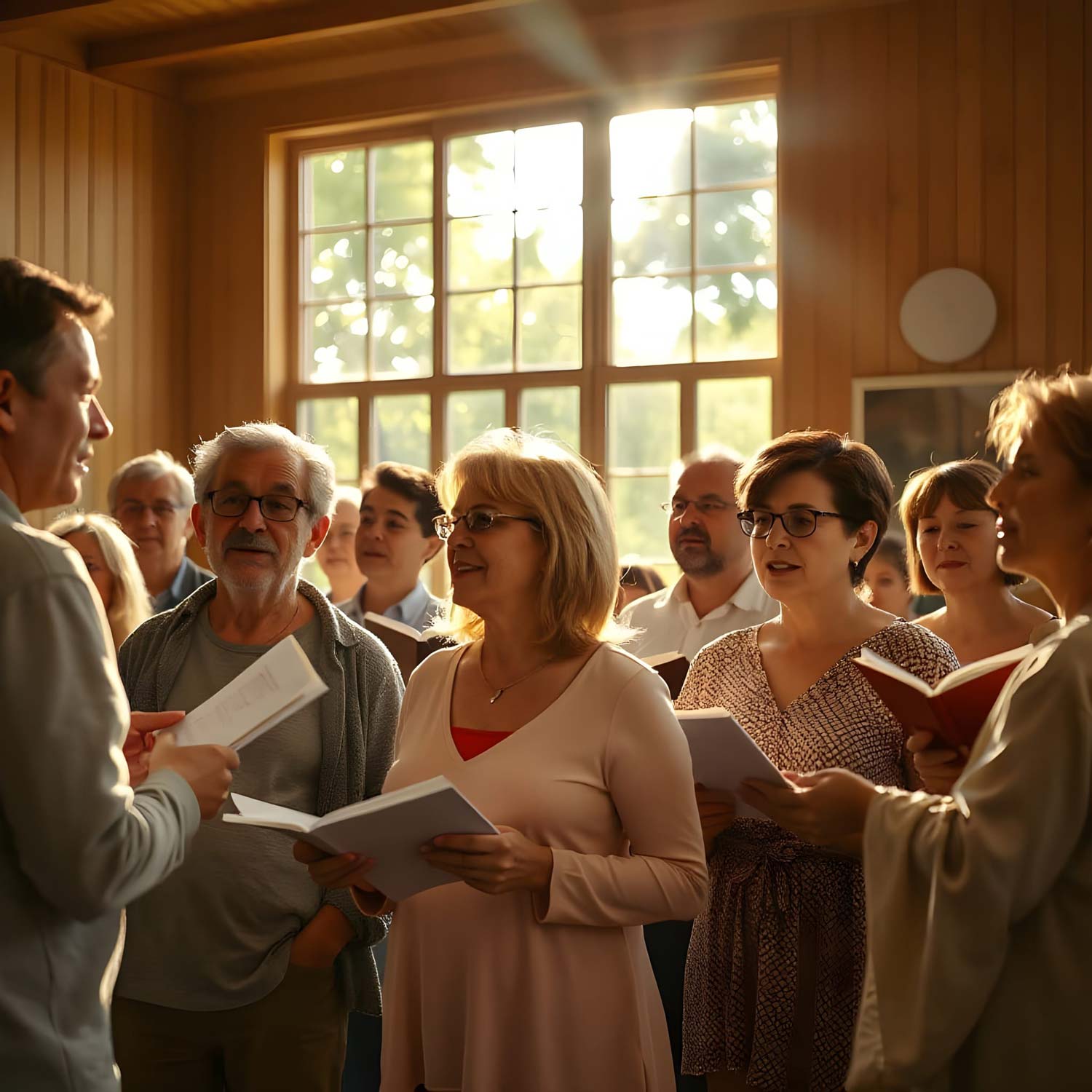
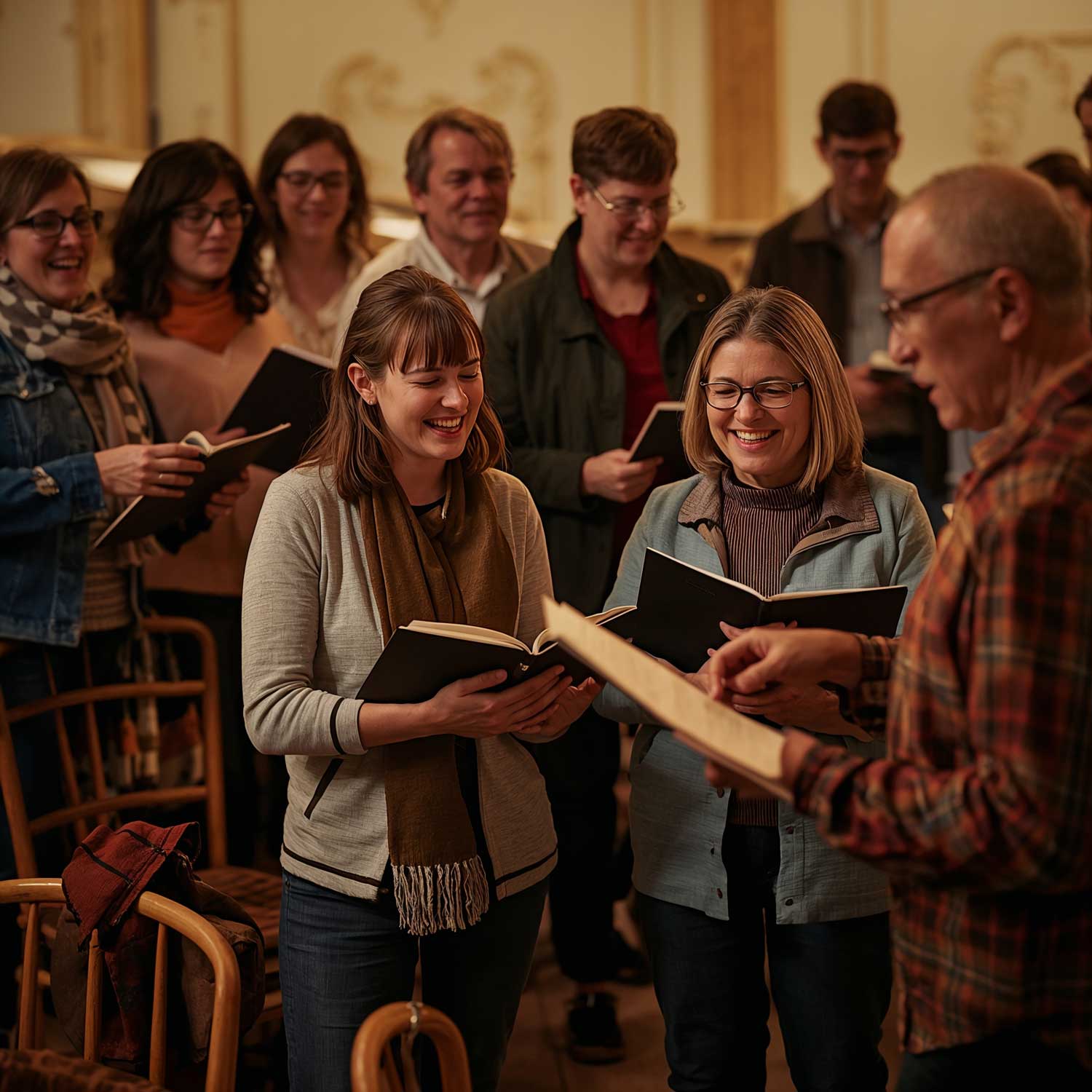
You arrive. Someone says hello. You sit down, usually with others singing a similar voice part, and the rehearsal begins. Sometimes it starts with a warm-up. This is not a test. It's not an audition. It's a series of gentle exercises designed to loosen the voice, focus the mind, and to be honest, to ease everyone into the room together. Even the experienced singers need it.
Then you work on the music. Piece by piece, section by section. You'll listen, you'll try, you might wobble on something and try again. At some point you'll get something right and it will feel wonderful. At some point the whole choir will come together on a phrase and the sound will be larger and richer than anything you imagined you were part of. That moment, and it always comes, is why people keep coming back.
Afterwards, people chat. Friendships form. It is, in the very best sense of the word, a community.
"What If I'm Too Old? Or Too Young? Or Too Busy?"
Too old? Genuinely, no. I have singers in their seventies who came to a choir for the first time in their sixties and now wouldn't miss a rehearsal for the world. Singing is one of those rare activities that has no upper age limit. In fact, research suggests that singing is one of the best things older adults can do for their cognitive and physical wellbeing. (We talked about that in a recent Green Room post, if you'd like to read more.)
Too young? Also no, though of course different groups suit different ages. If you're an adult, most community choirs will welcome you with open arms.
Too busy? This one I'll take slightly more seriously, because life is genuinely full. But most community choirs rehearse once a week for a couple of hours, and many members tell me that rehearsal night is the thing they protect most fiercely in their diary. Not because they feel obliged to. Because it's the best two hours of their week.
"What Kind of Choir Should I Look For?"
This is where it gets rather wonderful, because there are so many options. There are choirs that sing classical repertoire and choirs that sing pop. Gospel choirs. Musical theatre choirs. Male voice choirs. Rock choirs. Choirs that perform in concert halls and choirs that perform in village pubs. The variety is extraordinary.
My honest advice? Think about what music makes your heart lift. What comes on the radio and makes you want to sing along? Start there. Look for a choir that sings that kind of music, and go along to a taster session if one is offered. You'll know within the first twenty minutes whether it feels right.
Here on the Costa Blanca, the groups I direct — Cantãmus, Canto Mundial, the TheatreSong Collective, and the Vall del Pop Singers — each have their own character and repertoire, but they share the same fundamental spirit: they are genuinely welcoming, they are led with warmth and patience, and they are full of people who simply love to sing. If you're local and curious, the door is open. It always is.
The Only Thing You Need To Bring
Not perfect pitch. Not experience. Not a voice like an angel.
Just a willingness to show up.
That's it. Everything else comes with time and practice. You don't need to be ready. You just need to walk through the door.
Margaret, if you're reading this — and I suspect you are — this is your sign. The one you've been quietly waiting for.
Go. You are very much wanted.
If you're on the Costa Blanca and would like to find out more about any of my groups, or to have a completely no-pressure chat about which might suit you, please do get in touch. I'd love to hear from you — and very soon, I'd love to hear you sing.